Pump Servicing for Hospitals in London
Same-day response across London and surrounding areas
Healthcare buildings cannot lose water pressure. We provide pump servicing for hospitals, clinics, care homes and private healthcare sites across London and the surrounding areas — cold water booster sets, basement and sump pumps, pressurisation units and circulating pumps, all serviced to a documented schedule with 24/7 breakdown cover behind it.
Every visit is planned with the estates team: permits to work, isolation windows, infection control routes and out-of-hours access are agreed before an engineer arrives on site.
Resilience Comes First
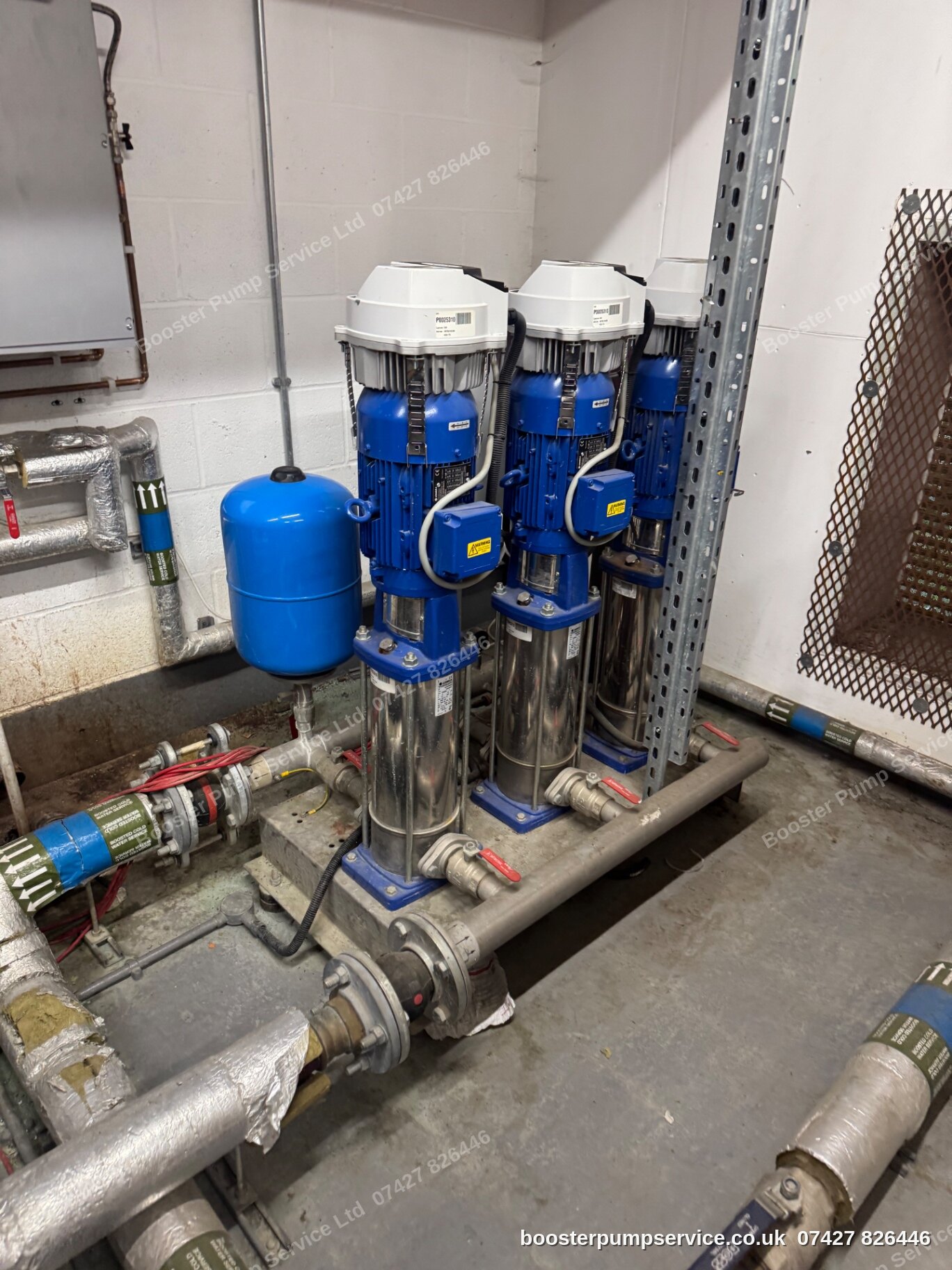
Hospital booster sets are almost always duty/standby or duty/assist/standby for a reason. A large part of our service work is proving that resilience genuinely exists: rotating duty, running each pump individually under load, testing changeover on a simulated failure, and confirming the set still meets its design duty with one pump out of service.
We also check the parts that quietly undermine resilience — a flat accumulator, a seized non-return valve, a standby pump that has not run in months, or an alarm that never reached the BMS.
- Duty/standby and duty/assist changeover proving
- Full duty test with one pump isolated
- Accumulator pre-charge and non-return valve checks
- BMS and alarm signal verification
- Variable speed drive parameter check and record
- Written service report per pump set
Working Around Clinical Areas
Plant serving theatres, wards and renal units cannot simply be switched off. We work to permit systems, agree isolation windows with the authorising engineer, and where necessary provide temporary boosting so pressure is maintained while a pump is stripped, repaired or replaced.
Noise, access routes and waste removal are all planned in advance, and engineers work to your infection control requirements when passing through clinical areas.
Water Safety and Documentation
Pump servicing in healthcare feeds directly into your water safety plan. Our reports record run hours, pressures, temperatures where relevant, condition of stored water plant, faults found and remedial recommendations with prices — written so they can be filed against HTM and L8 obligations without rewriting.
Where a pump is beyond economic repair we say so plainly, quote a like-for-like replacement, and flag the risk of leaving it in service so the decision can be escalated and budgeted properly.
24/7 Emergency Cover for Healthcare Sites
Healthcare contracts include round-the-clock emergency response. If a booster set fails overnight an engineer is dispatched immediately, with common seals, transducers, pressure switches and drive spares carried on the van so most failures are restored on the first visit.
Where a same-visit repair is not possible we arrange temporary pumps or hire sets to keep water moving until the permanent repair is completed.
Related Pump Services
- Our pump servicing for schools London is booked around term times for education trusts.
- Our emergency pump repair backs every healthcare contract 24 hours a day.
Frequently Asked Questions
Do you provide 24/7 cover for hospital pump failures?
Yes — healthcare sites get round-the-clock emergency response, with temporary boosting arranged if a permanent repair cannot be completed on the first visit.
Can you work to permit-to-work and infection control procedures?
Yes. Isolation windows, permits, access routes and infection control requirements are agreed with the estates team before any work starts.
What does a hospital pump service report include?
Run hours, pressures, duty/standby changeover results, drive parameters, condition of each pump, faults found and priced remedial recommendations — written for water safety plan and HTM records.
What does it cost?
Planned servicing starts from £280 + VAT per booster set and commercial emergency call-out is £350 + VAT. Multi-plant sites are quoted after a free survey.
Quick Answers
The questions people ask Google most often, with straight answers from our engineers.
- How often should a booster pump be serviced?
- At least once a year. Busy commercial buildings, hospitals and hotels usually have servicing every six months, in line with SFG20 schedules. A service covers pressures, motor currents, seals, vessel pre-charge, controls and alarms, and ends with a written report. Pump maintenance contracts
- How often should a booster pump run?
- A healthy booster set only runs while water is being drawn, then stops once pressure is reached. If it starts every few seconds with no taps open, or never stops, there is usually a leak, a failed non-return valve, a flat pressure vessel or a faulty pressure sensor. Booster pump fault finding
- What is on a booster pump maintenance checklist?
- Check suction and discharge pressures, cut-in and cut-out points, vessel pre-charge, motor currents, seals for leaks, bearings for noise, non-return valves, dry-run protection, break tank level controls, alarms and BMS signals. Then record everything in a written service report. Booster set maintenance
- How much does booster pump repair cost?
- Our Residential Booster Pump Call Out is from £220 + VAT and our Commercial Booster Pump Call Out is from £350 + VAT. Both cover the diagnostic call-out and the first hour on site. 24/7 Out-of-Hours Emergency attendance is from £320 + VAT. Parts are quoted before any work goes ahead. Full price list
Book Your Pump Servicing for Hospitals in London
Our commercial pump engineers are on call 24/7 — same-day attendance for emergencies, scheduled visits for PPM contracts.
Residential call-out from £220 + VAT • Commercial call-out from £350 + VAT • 24/7 emergency call out